With the advancement of technology, different methods have begun to be used for information flow. QR codes and barcodes are new technologies developed for this purpose and effectively used in many fields. So, what exactly do these technologies do? What are barcodes and QR codes? You can find the answers to these questions and other details about the codes in the rest of our article.
Contents
What is a QR Code?
QR codes suddenly became a part of people's lives and accelerated the flow of information. Instead of memorizing advertisements or similar information you encounter in daily life, it made it possible to access that information with a QR code. With a simple application on your mobile phone, you can instantly save the information and review it whenever you want. With this feature, it can be said that QR codes have accelerated the flow of information worldwide. So, what is a QR code?
QR codes are a two-dimensional barcode system. They were developed by Denso Wave, a Japanese company and a subsidiary of Toyota. Quick Response The name is an acronym for. These codes can be read using QR code reader applications installed on mobile phones, allowing access to relevant product or service pages. A good example of this recently, especially during the pandemic, is the ability to select menu items in restaurants using QR codes on your phone.
You might also be interested in: How to Achieve Maximum Efficiency in Product Coding?
What do QR and Data Matrix Codes Look Like?
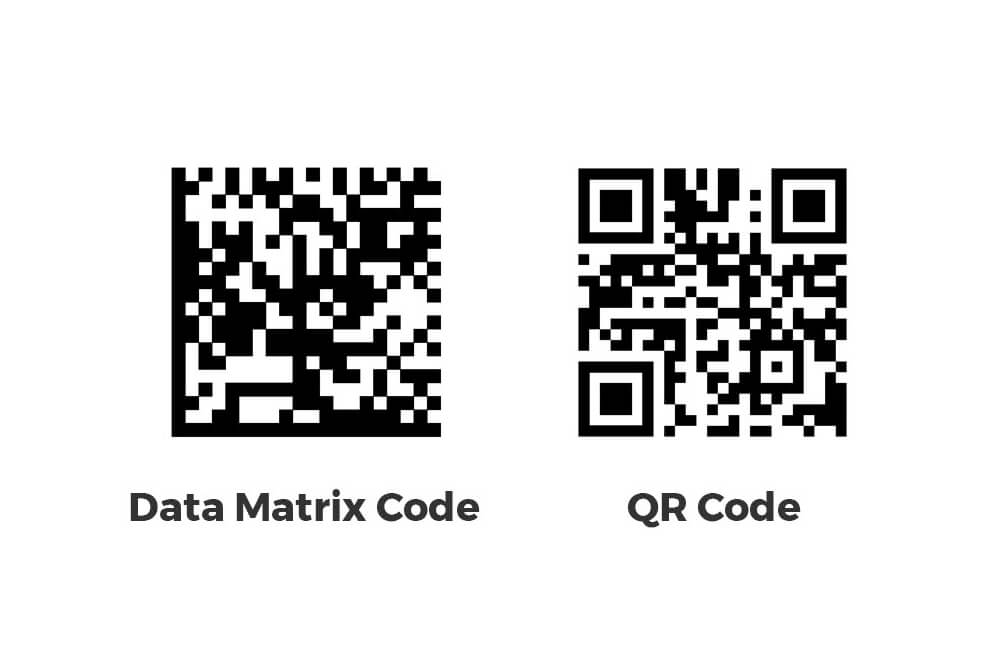
QR codes and Data Matrix codes are generally similar. Both are essentially pixels packaged in a box, making them difficult to distinguish from one another.
A close examination is necessary to distinguish between the codes. Although these codes generally show similarities, they are based on different technologies. Consequently, there are some visual differences.
A QR code has three large squares at its corners. These squares are used for embedded data for reading and identification purposes. The QR code itself uses a straight, black, L-shaped border.
What are QR and Data Matrix Codes Used For?
Both of these codes are expressed as two-dimensional barcodes or scannable images that can be used to hold alphanumeric data. While there are significant similarities between these codes, there are also distinct differences that set them apart.
QR codes are preferred because they have a higher data storage capacity. They can store 4,296 alphanumeric and 7,089 numeric characters. Another important difference is their compatibility with Kana/Kanji characters.
Like large data storage capacities, QR codes are expected to have a large physical size. However, compared to Data Matrix, which has a higher information density, they can be created with smaller sizes. They effectively enable the tracking of small products such as rounded surfaces and computer components.
Data Matrix codes, which can be printed in a smaller size, are notable for their capacity to store 2,335 alphanumeric and 3,116 numeric characters. They are not compatible with other character types, and consequently, their flexibility is limited.
Due to the specifics involved, Data Matrix codes are generally used in industrial settings, while QR codes have a more general range of applications.
You might also be interested in: 5 Things You Absolutely Need to Know When Buying a Marking Machine
Readability Requirements
Data Matrix has a high tolerance for physical damage and alterations, with a tolerance level of around 30%. Code readers have algorithms that allow for the reconstruction and filling of the problematic section resulting from physical damage or alteration. Thanks to these algorithms, the code becomes readable again.
The tolerance for physical damage to QR codes ranges from 7% to 30%. In addition, a minimum contrast ratio between the shadows of lighter and darker pixels is required for readability. For QR codes to be readable without problems, they must be printed with colors that have a 40% contrast ratio among themselves. This ratio is 20% for Data Matrix. Therefore, Data Matrix codes do not experience readability problems even if printed in almost the same color.
Data matrix codes can be scanned using versatile camera scanners and code scanners. Because they are designed for industrial use, reading them with some smartphone cameras requires third-party applications.
QR codes, on the other hand, can be easily read with a phone camera without the need for a third-party application. Customer-focused applications often use QR codes with more clarity compared to Data Matrix codes.
The Code Printing Process
Codes must be printed correctly to function properly. When choosing an inkjet coding machine, it's crucial to ensure it's suitable for the code to be printed. Details such as the printing application and code validation system are of paramount importance.
QR and Data Matrix codes have a higher error tolerance compared to traditional dimensional barcodes, but it is crucial that the codes are printed cleanly and accurately.
Best Printers for QR and Data Matrix Codes
For QR and Data Matrix codes, the Rynan R20 Pro and Rynan R20 Max models fully meet expectations. These models are suitable for needs in sectors such as pharmaceuticals, cosmetics, and food. Both the Rynan R20 Pro and Max models are capable of high-resolution printing,reaching a resolution of 300 dpi.
Another option for printing QR and Data Matrix codes is the Smartech CI8550 inkjet coding device, although its print quality is slightly lower than Ryanan models. However, thanks to its CIJ technology, it can print contactless on curved and curved surfaces from a distance of 30-40 mm. This is one of the device's advantageous features.
 As Electrojet, for Rynantech (Thermal Inkjet), a Singapore-based company that is a leading firm in the sector with distributors in 65 countries we are the main distributor in Turkey. We offer professional solutions for all your coding and marking needs. Contact us today for more detailed information.
Contact us to. learn about the most suitable equipment for your business and receive FREE information about them
